
The Cubist Female Silhouette
Prof. Francesco Carelli
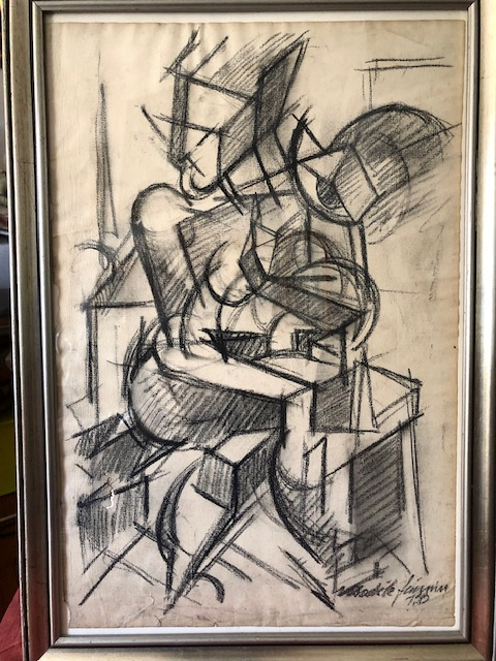
Charcoal and grease pencil
Characteristics of the Cubist Female Silhouette are Geometrization, through which breasts, hips, and the face become cones, spheres, and cylinders; then Poly-perspective, through which the figure is represented simultaneously from the front and in profile; and then the Overlapping of planes, through which the background and the body merge, eliminating the traditional distinction between figure and space. Pablo Picasso and Georges Braque co-founded Cubism, working closely together in Paris between 1908 and 1914, so much so that Braque compared their union to that of “two mountaineers roped to the same line”. Despite their profound collaboration, their styles maintain fundamental differences linked to their distinct artistic personalities.
Picasso is Expressive, Dynamic, and Impetuous… Picasso tackles the decomposition of the female silhouette with an emotional, dramatic, and often aggressive charge. For Picasso, the deformation of the body is a tool to express passions, sensuality, or pain… his lines are sharp and his geometric shapes are crisp, angular, and charged with a strong dynamic tension. His initial and constant inspiration derives from African tribal art and ancient Iberian sculpture, which lead him to create monumental and almost sculptural figures.
Braque is Lyrical, Meditative, and Structured; a house painter-decorator by training, he has a methodical, poetic approach focused on the formal harmony of space. He has an intellectual approach through which he seeks geometric balance and the study of the “tactile” space between objects, reducing emotional impact in favour of visual reflection; his lines are soft, his decomposition is more fluid, blended, and integrated into the pictorial context, and he introduces the use of sand, sawdust, and stencil letters onto the canvas. He is the inventor of papiers collés, pasted papers, to insert elements of daily reality into the painting. When he paints the female silhouette, it merges almost completely with the background, becoming one with the environment.