
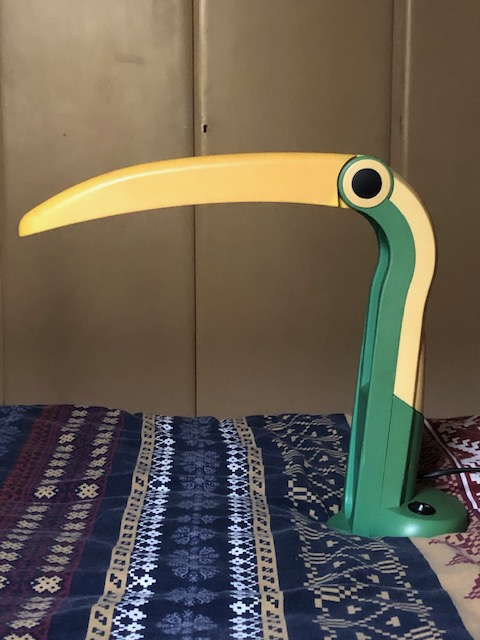
Toucan lamp: an icon of Italian design
Prof. Francesco Carelli
It was in 1970, when was created the Toucan lamp, the first lighting product made of plastic specifically for children. In recent years it has returned to being a much sought-after product among collectors around the world.
The mind behind this iconic product is designer Enea Ferrari, founder of Old Timer Ferrari (OTF), which later became Linea Zero. A lover of reading, art, physics and cultural travel, Enea found inspiration in real life to create objects and lamps. Manual skills and a strong artisan aspect have always characterized his creations, so much so that he often spent entire days with artisan friends in order to learn the tricks of the trade and make them his own.
All the products made by Enea were handmade in the prototype phase, to be then industrialized for the real production. The materials used in the first period were metal, sheet metal and wood. Later, starting with the creation of the Toucan, he began to design lamps in plastic. In this case, the design was from Huo – Tu Huang.
The desire to experiment led Enea Ferrari to try his hand with the then innovative polypropylene Moplen (ABS), a plastic material for industrial use with excellent electrical and chemical resistance. Shortly thereafter, Enea created the world’s first children’s lamp of that type and material, the Toucan. The product was so successful that it inspired other designers to create similar products, creating a trend that is still sought after today.
The Toucan remained on the market for about 6 years, sold in Europe mainly through lighting distributors and wholesalers. After having produced thousands of pieces under the OTF brand, in 1973 the marking was changed from OTF to Linea Zero. In addition, the lamp was renamed Cocorì.
As a result, over the years, models of the lamp have been produced under both the OTF brand and the Linea Zero brand. Moreover, there are several models that, for purely commercial purposes, do not bear any brand name. Some large foreign importers have in fact requested and obtained this small variation. In any case, these changes do not affect the originality, the important thing is that the shape of the body, beak and foot is identical. In fact, there is no version with different dimensions, while the colours of the various parts that make up the Toucan can vary. Unfortunately, in the mid-70s, the success of this lamp has been waning. However, in recent years, the Toucan has returned to success becoming object of desire among lovers of modern antiques and vintage products.