
Kasuba, a visionary artist
Prof. Francesco Carelli
A major exhibition at Tate St Ives host Kasuba’s works who was a visionary artist, often inspired by forms found in nature, such as shells, rocks, vegetation and marine life. Driven by a desire to forge a deeper connection between humanity and the natural world, Kasuba created art that imagined alternative ways of living. Kasuba’s work drew on different disciplines, and in the late 1960s, she collaborated with the Experiments in Art and Technology (EAT) group, made up of artists, engineers and scientists
The exhibition at Tate St Ives shows a range of Kasuba’s sculptures, models, mosaics, paintings, drawings and collages from the collection of the Lithuanian National Museum of Art, where the artist donated her works, including her spatial environments. Made of tensile fabrics and without right angles, these immersive spaces imagined a more harmonious and peaceful way of living. The artist famously told The New Yorker in 1971 that she wanted to ‘kill the square. Conventional rooms with four walls dictate too much to the people in them. Relationships are different here. People who come here find themselves behaving differently.’
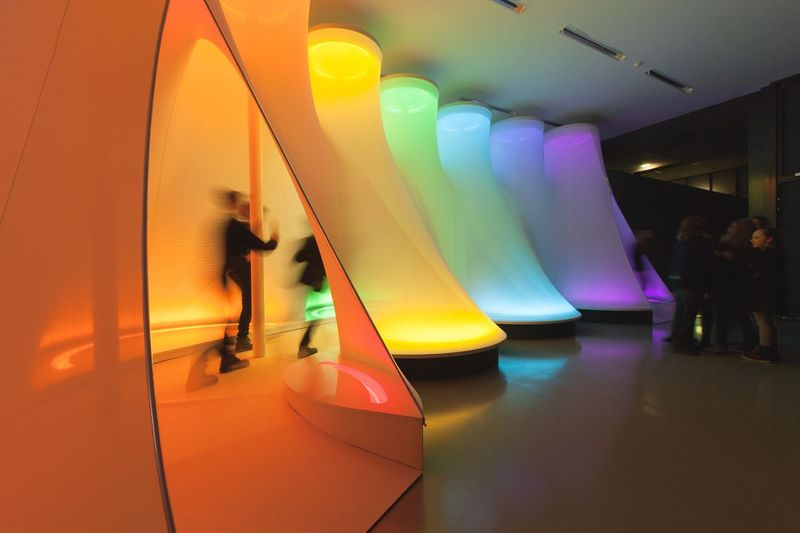
Spectrum: An Afterthought, 1975, one of Kasuba’s most significant spatial environments, is displayed in its entirety. The work is a passageway comprising brightly lit, different coloured zones and is made of aluminum, neon, plastic, plywood, steel and tensile fabric. It is accompanied by the sounds of cosmic wind arranged by composer Paulius Kilbauskas, as well as a selection of scents created by perfumer Danutė Pajaujis Anonis, which mirror the different colours of the sculpture, reflecting Kasuba’s interest in synesthesia.