
Hurvin Anderson at Tate Britain
Prof. Francesco Carelli
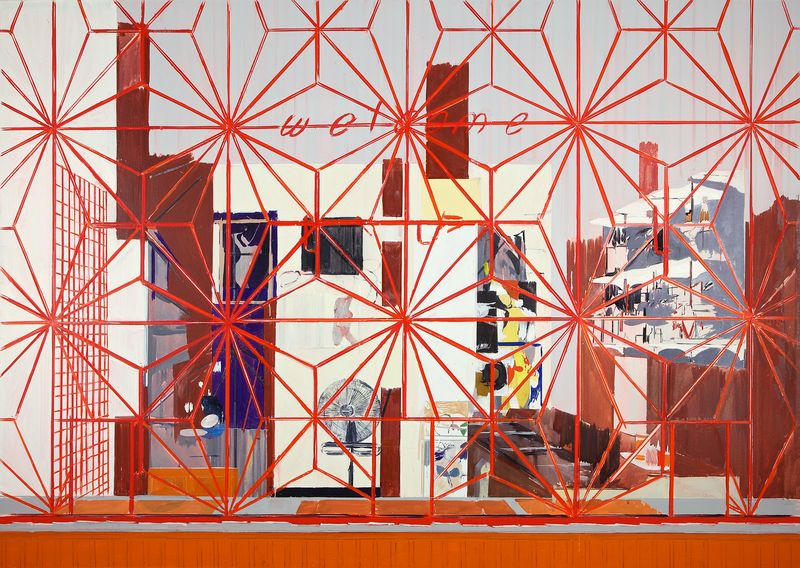
a Caribbean bar through a red security grille
(From Tate Britain dropbox press release)
Tate Britain stage the first major survey exhibition of British artist Hurvin Anderson. Bringing together around 80 works, the show is spanning the artist’s entire career, from formative work to present day, including a room of never-before-seen paintings. Through colour-drenched landscapes and interiors, Anderson’s work weaves back and forth across the Atlantic, between the UK and the Caribbean, reflecting on his experiences of belonging and diaspora, evoking a sense of, as he puts it, ‘being in one place but thinking about another’. Thanks to his profoundly atmospheric use of composition to explore the markers of identity, and his deep-rooted engagement with traditions of British landscape painting, this exhibition confirms Anderson’s standing as one of the most important contemporary painters of his generation.
The exhibition reflects this bylooping back and forth, following a thematic journey through the artist’s30-year practice. Family photographs, early portraits and studies depicting family members set the scene of his boyhood where the artist plays with time, conflating past and present to invent imagined familial support systems and transitory memories.
A key development in Anderson’s unique visual language is explored through four paintings from his Ball Watching series (1997-2003), which established his preoccupation with revisiting and reformulating different elements of the same subject across multiple works. Derived from a photograph he took of his friends watching their football in the water in Handsworth Park in Birmingham, the artist transforms a recognisable image of Englishness into a tropical locale by layering one location onto another. This series combines Anderson’s central thematic concerns, including the unreliability of memory and tension around cultural heritage.
A significant element of Anderson’s practice is his re-imagining of public spaces that have individual and cultural significance. The barbershop is a subject that the artist has returned to throughout his career and is imbued with social history and personal meaning. His prolific Barbershop series (2006-2023) references a period in the 1950s and 60s when Caribbean immigrants created make-shift barbershops in their homes, serving as places for social gatherings, as well as for economic enterprise.
The series, together with Peter’s series (2007-9) have become his best-known works. From the latter, Tate Britain present Peter’s Sitters II 2009, focusing on an anonymous figure in a chair, while early Barbershop compositions including Jersey 2008 are shown alongside some of his most recent works, including Skiffle and Shear Cut(both 2023). A major highlight of the exhibition is the UK debut of Anderson’s monumental Passenger Opportunity 2024-5, inspired by two murals painted by Carl Abrahams in 1985 for Jamaica’s Norman Manley International Airport. Serving as a loose historical record of emigration from Jamaica to Britain from the 1940s to the 1970s, the 24-panel piece is reconceived and reworked to reflect its fresh presentation, with new historical narratives which delve into the relationship between Britain and the Caribbean.
Tate Britain present four works from the artist’s Welcome series, depicting a Caribbean bar through a red security grille, observed on this trip. The artist’s use of fencing or grilles seeks to distance the viewer, creating a physical and emotional separation. This situates the viewer firmly on the outside.